Getting to Padua
17th Conference of the International Society for Tryptophan Research (ISTRY)

Airports
The closest international airports nearby are:
Venice Marco Polo Airport (VCE / LIPZ), ~45-50 km (https://www.veneziaairport.it/en_gb/)
Treviso Airport (TSF / LIPH) (https://www.trevisoairport.it/en_gb/).
From both airports there is the possibility to travel to Padua (Padova) by train. See train for more details.

Train
The central station in Padua is called Padova Centrale (sometimes written simply as Padova on Italian rail timetables)
Italian Railway companies:
Trenitalia (Italy’s national rail operator, covers regional trains and most high-speed trains): www.trenitalia.com
Italo (a private company that runs high-speed trains on major routes, including Venice ↔ Padua ↔ Milan/Rome): www.italotreno.it
Both allow online booking in English and show real-time timetables.
Getting from international airport to Padua (Padova) by train
From Venice Marco Polo Airport (VCE) to Padua, there’s no direct train station at the airport itself, but here’s the usual route:
- Airport → Venezia Mestre railway station
- Take the ATVO or ACTV airport bus (about 20–25 minutes).
- Alternatively, a taxi will take ~15 minutes.
- Venezia Mestre → Padua (Padova) by train
- Trains run very frequently (every 15–30 minutes).
- Regional trains take ~30–40 minutes, high-speed Frecciarossa or Italo ~15–20 minutes.
- Tickets range from ~€5 (regional) to ~€15–20 (high-speed).
Total travel time: around 1–1.5 hours.
From Treviso Airport (TSF):
- Shuttle bus from the airport to
- Train from Treviso Centrale to Padua (~50–60 minutes, sometimes with a change at Mestre).

Car
For those driving within EU, key points to note:
1. ZTL (Zona a Traffico Limitato)
- Like many Italian cities, Padua has restricted traffic zones in the historic center.
- Only residents, public transport, taxis, and permitted vehicles can enter during certain hours.
- Cameras automatically fine cars (including foreign plates), and fines are mailed internationally.
- Best to park outside the ZTL (e.g., at a park-and-ride lot or larger car parks near the train station) and walk or use public transport.
2. Motorways (Autostrade)
- Italian highways are toll roads (marked A + number, e.g. A4).
- Collect a ticket when you enter and pay (cash, card, or Telepass) when you exit.
- Speed limits: 130 km/h (motorway), 110 km/h (main roads), 50 km/h (urban).
3. Parking
- Blue lines = paid parking.
- White lines = free (often for residents or limited time).
- Yellow = restricted (taxis, deliveries, disabled).
- Car parks like Padova Stazione or Piazzale Boschetti are practical options.
4. Environmental rules
-
Veneto sometimes imposes restrictions on older diesel/petrol cars during winter for air quality. If you’re driving a modern Euro 5/6 vehicle, you’re fine.
5. Documents
- Valid driver’s license (EU licenses are accepted).
- Vehicle registration and insurance (green card if requested by your insurer).
- Safety kit: reflective vest, warning triangle (mandatory in Italy).
6. City driving style
- Italian city traffic can be fast and assertive, with lots of scooters.
- Narrow streets in the historic center are best avoided with a car.
🚗 Tip: Many visitors prefer to park outside Padua and use tram/bus into the center.
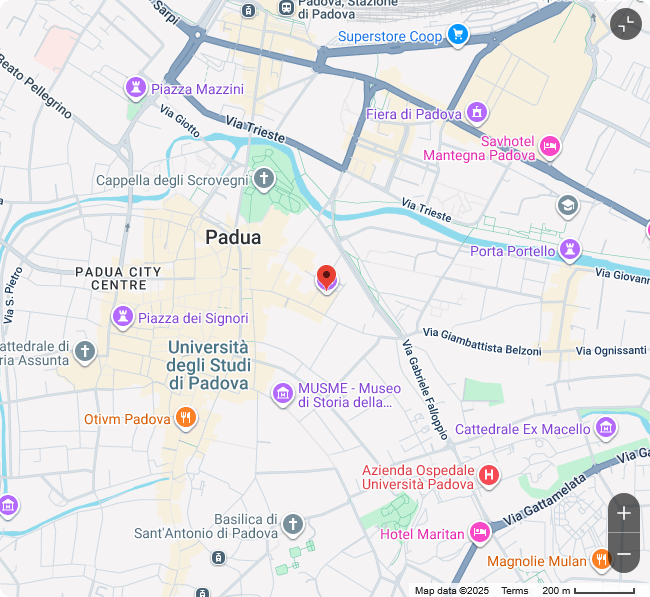
Day 1: Palazzo Bo, University of Padua
https://maps.app.goo.gl/44PwX4QRWFsbcyCm8
Days 2 & 3: Cultural Center Altinate San Gaetano